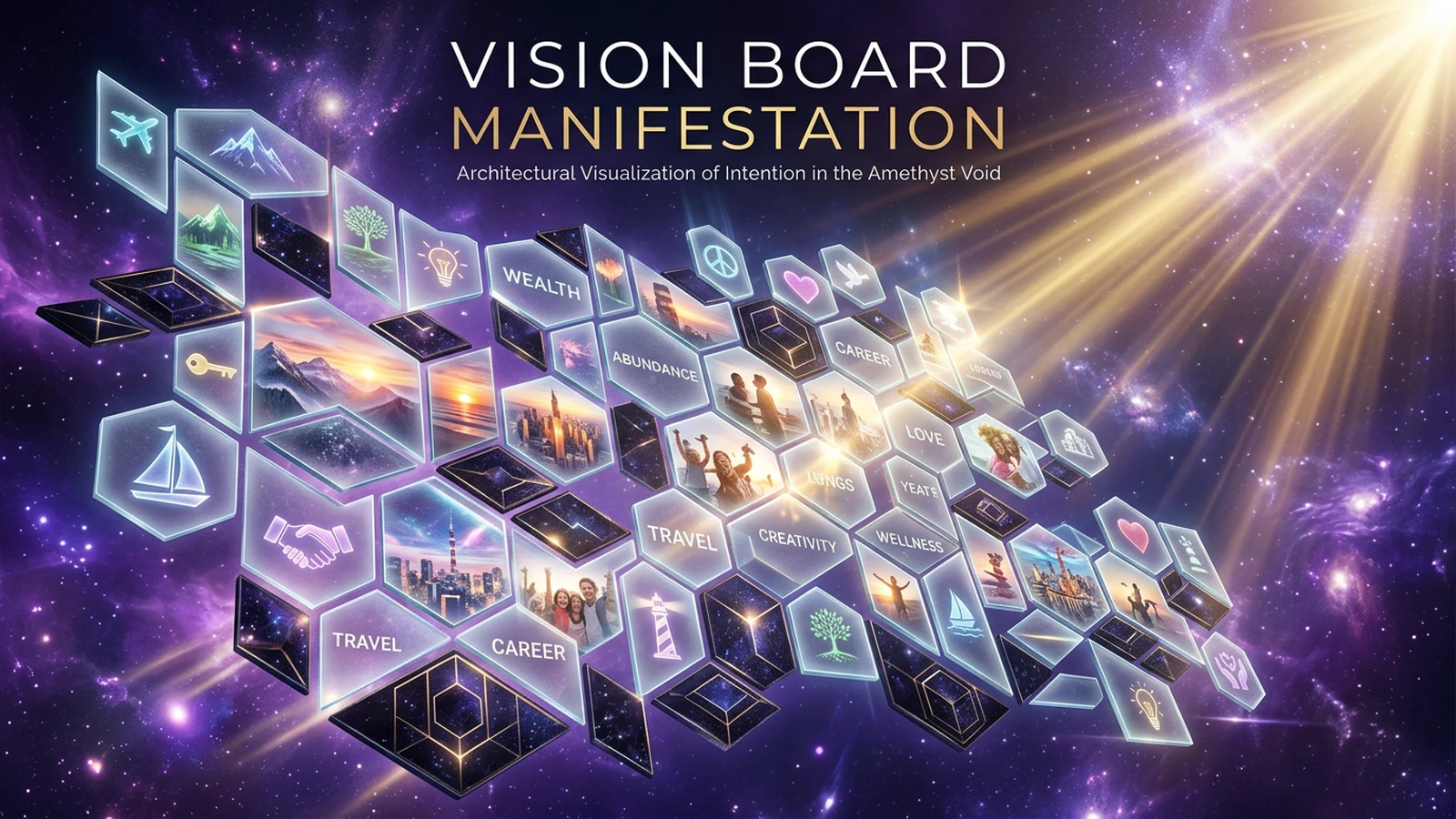
Vision Board Manifestation: How to Build Your Dream Reality
Key Takeaways
- • Create a vision board with emotionally meaningful images that evoke peace or excitement and make your goals easier to revisit.
- • Use your vision board daily as a visual focus tool to notice opportunities and next actions aligned with your goals.
- • Set specific intentions in key life areas before selecting images so your vision board becomes more than a generic wish list.
We’ve all seen them: poster boards covered in magazine cutouts of private jets, mansions, and perfect bodies, tucked in the corner of someone’s bedroom. Many people view vision boards as a fun arts-and-crafts project for New Year’s Eve, but few understand how to utilize them as a serious manifestation tool.
If your vision board consists of slapping pictures of Ferraris onto a piece of cardboard, looking at it once a month, and wondering why you aren’t rich yet, you are missing the crucial psychological component of visual manifestation.
A true vision board is not a wish list; it is a visual focus tool. When built and used consistently, it can help you revisit what matters, notice related opportunities, and choose more aligned actions. Here is the complete guide on how to build a vision board that bridges the gap between where you are and where you want to go.
The Psychology: Why Vision Boards Can Help
You might think vision boards are pure “woo-woo” spirituality, but a grounded version maps well to attention, motivation, and visual priming.
Visual Priming and Value Tagging
Your brain processes visual imagery quickly. When you look at an image that represents a deep desire, that image can become a recurring cue for what you want to notice and practice.
Once an image becomes personally meaningful, your attention may start scanning your environment for related details.
If you put a specific model of a car on your board, suddenly you see that car everywhere on the highway. Your brain didn’t spawn the cars out of thin air; it simply stopped filtering them out. By looking at a vision board daily, you are priming your attention to notice resources, people, and opportunities that align with your goals.
🔍 Community Insight (synthesized): The “Aha” Moment Across vision board discussions, one element shows up again and again: emotion. Boards tend to feel more useful when the images create a real bodily feeling of peace, excitement, safety, or possibility instead of simply displaying what someone thinks they “should” want.
How to Create a Vision Board That Actually Manifests
Throwing a pile of Vogue magazines onto the floor and cutting out pretty pictures is a recipe for a weak vision board. To build a useful manifestation tool, follow these four steps.
Step 1: Set Specific Intentions First
Do not look for images yet. Take out a journal and write down exactly what you want your life to look like one year from today. Break it down into categories:
- Career & Finances
- Love & Relationships
- Health & Wellness
- Personal Growth & Experiences
Get incredibly clear on the feeling you want to achieve in each category. You aren’t just manifesting a house; you are manifesting the feeling of stability and warmth.
Step 2: Curate Impactful Images & Quotes
Now, find your visuals. You can use old magazines, Pinterest, or Google Images.
The Golden Rule: Every single image you place on your board must elicit an emotional response in your body. If you look at a picture of a stack of money and feel nothing but anxiety about your debt, Do not put it on the board. Swap it for an image that represents financial freedom to you—perhaps a picture of a “Paid in Full” stamp or someone relaxing without a care in the world.
Mix your images with powerful affirmation words: Freedom, Peace, Unstoppable, Loved.
Step 3: Physical vs. Digital (Which is Better?)
- Physical Boards (Corkboard or Poster): These can feel more engaging because the tactile process of cutting and gluing forces you to spend more time with the images. Hang it in your bedroom or office.
- Digital Boards (Canva or Pinterest): Ideal for people who travel or spend all day on their laptops. Set your digital vision board as your phone lock screen and desktop wallpaper. You will subconsciously view it over 100 times a day.
Pro Tip: You don’t have to choose. Make a physical board for your bedroom and a digital board for your phone lock screen.
Step 4: Organize by Life Areas (The Bagua Map)
While you can arrange images intuitively, many practitioners use the Feng Shui Bagua Map layout to create energetic balance.
- Top Left: Wealth and Abundance
- Top Center: Fame and Reputation
- Top Right: Love and Relationships
- Center: Health
- Bottom Center: Career and Life Path
Why Vision Boards Fail (Avoid These 2 Mistakes)
1. The “Set It and Forget It” Trap You cannot hide your vision board in a closet or let it gather dust in a hallway you never walk down. The method requires daily visual engagement. Spend 60 seconds every morning looking at the board, breathing deeply, and stepping into the emotion of the images as if they are your current reality.
2. The Action Disconnect Your vision board cannot make phone calls, send emails, or go to the gym for you. The board changes your brain’s filter so you recognize the open doors, but you still have to walk through them. Let the board inspire your daily inspired action.
Final Thoughts
Your vision board is a living document. As you grow, your desires will naturally shift. Do not be afraid to rip an image off your board if it no longer resonates with your soul, or add new ones as your vision expands.
Curate your images, hang the board where you will see it every time you wake up, and let your subconscious mind build the blueprint for your dream reality.
Frequently Asked Questions
Why can vision boards help with manifestation?
Vision boards can help because visual imagery gives your goals a recurring cue, making related opportunities, emotions, and next actions easier to notice.
How can I create a vision board that supports my goals?
First set specific intentions in areas like career and relationships, then choose emotionally meaningful images, and view the board daily while taking aligned action.
What is the role of emotion in vision board practice?
Emotion anchors your vision board by connecting images to feelings of peace or excitement, transforming it from a generic wish list into a more meaningful focus tool.